Why
A seventy-year contract, pushed to its breaking point
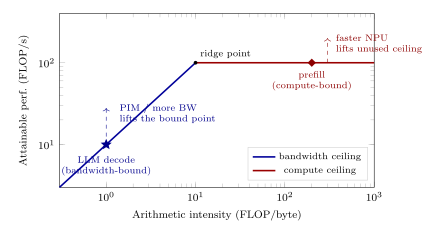
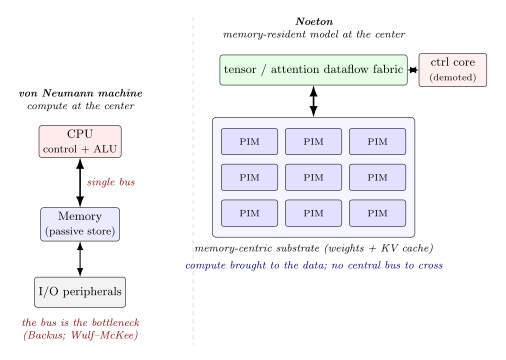
For seventy years the computer has been a von Neumann machine. Foundation-model inference breaks the deal: the dominant cost is not arithmetic but moving vast, mostly static weight tensors and a growing KV cache. Autoregressive decode is bound by memory bandwidth, not FLOPs. The industry’s current answer — the “AI PC”, a von Neumann machine with an NPU bolted on — is a transitional form, not the final one.
From the abstract
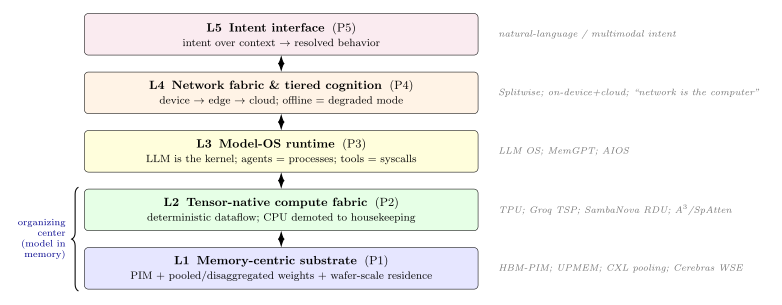
We argue for redesigning the machine around the model, from the hardware up. We name the
result the Noeton (from Greek noesis, “the act of understanding”),
and its organizing principle the Model-Native Architecture. We ground each principle in
existing research — the memory wall, processing-in-memory, CXL pooling, wafer-scale
integration, deterministic dataflow processors, and emerging LLM operating systems — and
synthesize them into a coherent reference design. We do not build the Noeton; this is a
position paper, offered as a target worth arguing about, with its costs taken seriously.